
The Future of Customer Service Starts Now
Artificial intelligence is currently transforming nearly every aspect of customer communication. Many companies are exploring copilots, AI agents, and the automation of service processes. At the same time, service organizations face the challenge of meeting rising customer expectations with limited resources. The key question, therefore, is no longer whether to use AI, but how humans and AI will work together efficiently in the future.
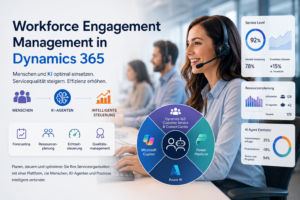
With the new Workforce Engagement Management (WEM), Microsoft is expanding Microsoft Dynamics 365 Customer Service and Dynamics 365 Contact Center with features that enable precisely this kind of collaboration. For us at primeone, this is another important step toward a smart service organization, where technology is not viewed in isolation but as an integral part of end-to-end business processes.
Customer service is becoming more complex
In our client projects, we regularly find that while companies have modern CRM and service platforms, resource planning, service level management, and quality assurance are often still handled in separate systems or even in Excel spreadsheets. This results in disjointed workflows, a lack of transparency, and a high level of manual effort.
At the same time, the number of communication channels is steadily increasing. Customers expect quick responses—regardless of whether they contact a company via email, phone, chat, or digital self-service portals. This makes it increasingly difficult for service organizations to deploy the right number of employees at the right time while ensuring a consistently high level of service.
This is exactly where workforce engagement management comes in.
From Resource Planning to Smart Service Organization
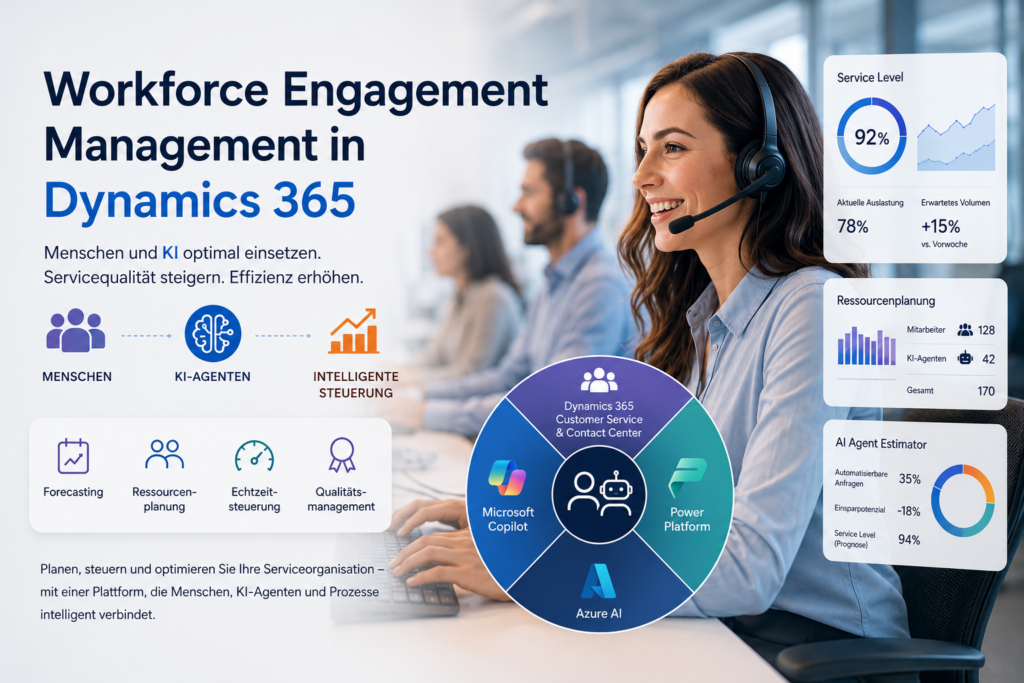
Microsoft integrates the planning, management, and optimization of service organizations directly into the Dynamics 365 platform. Forecasts are no longer based solely on historical data, but on actual customer interactions and current trends.
This provides service managers with a much more accurate basis for resource planning and enables them to identify early on how demand, capacity utilization, and service quality will develop. Decisions are no longer made based on assumptions, but rather on current data and forecasts.
The result is more predictable service processes, greater transparency, and the ability to respond more quickly to changes.
In the future, humans and AI will work as a team
What’s particularly exciting is the new approach of viewing not only employees but also AI agents as part of the service organization. While companies have primarily discussed the use of AI up to now, Microsoft is now, for the first time, providing tools to make the actual benefits of these technologies measurable.
Organizations can simulate which inquiries can be processed automatically in the future, what impact this will have on staffing needs and service levels, and how investments in AI will affect efficiency and customer satisfaction in the long term.
For companies, this represents a fundamental shift. In the future, customer service will no longer be provided exclusively by humans, but by teams consisting of employees and intelligent agents.
The real challenge, however, does not lie in the technology itself. The key question is how processes should be designed so that people and AI can work together optimally. Which inquiries should be automated? When does it make sense to hand off a request to a service representative? What data is needed for AI to actually add value?
These are precisely the issues that many companies are currently grappling with.
Technology alone does not create added value
At primeone, we have been supporting our customers for many years as they digitize their marketing, sales, and service processes using Microsoft Dynamics 365. Time and again, we see that sustainable success does not come from implementing individual features, but rather from the interplay of technology, processes, and people.
Workforce Engagement Management fits seamlessly into this approach and expands the capabilities of Dynamics 365 by adding a key component for modern service organizations.
Our experience shows that companies benefit most from new technologies when they are integrated into existing business processes and solve specific challenges. That is why we never view topics such as AI, automation, or workforce management in isolation, but always within the broader context of the customer experience.
The strength lies in the platform
Workforce Engagement Management becomes particularly interesting when combined with other Microsoft technologies such as Dynamics 365 Customer Service, Dynamics 365 Contact Center, Dynamics 365 Customer Insights, the Power Platform, and Microsoft Copilot.
This provides companies with an integrated platform that connects customer information, service processes, automation, and AI capabilities. Instead of isolated applications, a centralized customer experience platform is created that enables a holistic view of customers, employees, and services.
This is exactly the approach we take at primeone in our projects. Our goal is not to implement individual systems, but to create solutions that integrate marketing, sales, and service and support the entire customer lifecycle.
Why this topic is relevant right now
Many companies are currently facing the challenge of making their service operations more efficient without compromising customer satisfaction. At the same time, AI technologies are opening up entirely new possibilities for automating the handling of routine inquiries and specifically reducing the workload on employees.
Workforce Engagement Management provides the transparency needed to harness this potential in a controlled and measurable way. Companies can make informed decisions, allocate their resources more effectively, and at the same time improve the quality of their services.
This makes WEM a key component for companies that want to future-proof their customer service.
Our Conclusion
For us, workforce engagement management is much more than just traditional workforce planning software. It is an important step toward a smart service organization in which people and AI work together to provide customers with a better experience.
Microsoft provides the technological foundation for this. However, the real added value comes from having the right strategy, the appropriate processes, and a smooth implementation.
As a Microsoft Solutions Partner, we help companies follow exactly this path—from strategic consulting through implementation to the continuous optimization of processes. After all, the future of customer service isn’t shaped solely by new technologies, but by their intelligent application in day-to-day business.